
Statics
Engineering Mechanics – Statics
Branches of Mechanics
Mechanics is the physical science dealing with the state of rest or motion of bodies under the action of forces. The three main branches of mechanics are:
- Statics: Bodies in state of rest.
- Dynamics: Bodies in motion under force action.
- Kinematics: Motion without reference to causing forces.
ME Board March 1998
Example. Assume three force vectors intersect at a single point: \(F_1 = 4i + 2j + 5k\), \(F_2 = -2i + 7j - 3k\), and \(F_3 = 2i - j + 6k\). Determine the magnitude of the resultant force vector \(R\).
Solution. Sum the component vectors to find the resultant vector \(R\):
Compute the magnitude of vector \(R\):
Answer: 12 units
Condition of Equilibrium
A body is in equilibrium when the resultant of all forces acting on it is equal to zero.
- Graphical condition: Force polygon must close completely.
- Directional condition: Non-parallel forces must be concurrent.
- Analytical condition: Forces satisfy three static equations.
Equations of Static Equilibrium
Example. Three forces, \(20\text{ N}\), \(30\text{ N}\), and \(40\text{ N}\), are in equilibrium. Find the largest angle they make with each other.
Solution. Construct the closed force triangle and apply the law of cosines to solve for the maximum angle \(\theta\) opposite the largest force (\(40\text{ N}\)):
Answer: 104.48°
Friction
Friction is defined as the limited amount of resistance to sliding between the surfaces of two bodies in contact. The resisting force acts opposite to the direction of impending motion.
- Frictional force: Product of normal force and friction coefficient.
- Normal force: Perpendicular contact reaction force.
- Angle of friction: Angle between normal reaction and total reaction.
Limiting Friction Formula
Where: \(F\) = frictional force, \(\mu\) = coefficient of friction, \(N\) = normal force, \(\phi\) = angle of friction
EE Board October 1997
Example. A \(100\text{ kg}\) weight rests on a \(30^\circ\) inclined plane. Neglecting friction, how much pull must one exert to bring the weight up the plane?
Solution. Resolve forces parallel to the inclined surface:
Answer: 50 kg
CE Board November 1996
Example. A \(40\text{ kg}\) block is resting on an inclined plane making an angle of \(20^\circ\) from the horizontal. If the coefficient of friction is \(0.60\), determine the force parallel to the incline that must be applied to cause impending motion down the plane.
Solution. Calculate the normal reaction \(N\) and maximum static frictional resistance \(F\):
Set up the equation for impending motion down the plane:
Answer: 87 N
Belt Friction
Belt friction describes the transmission of power or frictional holding force when a flexible belt, rope, or cable is wrapped around a cylindrical pulley or drum.
- Tight side tension: Higher tension pulling against friction.
- Slack side tension: Lower tension on the opposite side.
- Contact angle: Angle of wrap expressed in radians.
Belt Friction Relation
Where: \(T_1\) = tight side tension, \(T_2\) = slack side tension, \(\mu\) = coefficient of friction, \(\beta\) = angle of contact in radians
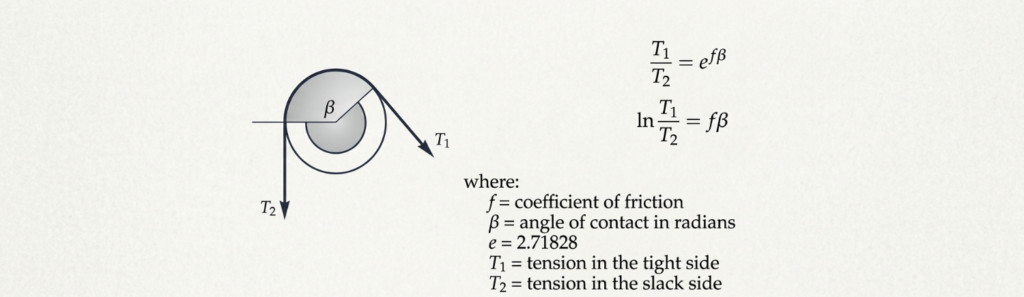
Example. A flexible rope is wrapped around a fixed cylindrical post with a contact angle of \(\pi\text{ radians}\). If the coefficient of friction between the rope and post is \(0.30\) and a pull of \(100\text{ N}\) is applied on the slack side, find the maximum load \(T_1\) that can be supported on the tight side before slippage occurs.
Solution. Apply the belt friction formula using \(\beta = \pi\text{ rad}\) and \(T_2 = 100\text{ N}\):
Answer: 256.63 N
Parabolic Cables
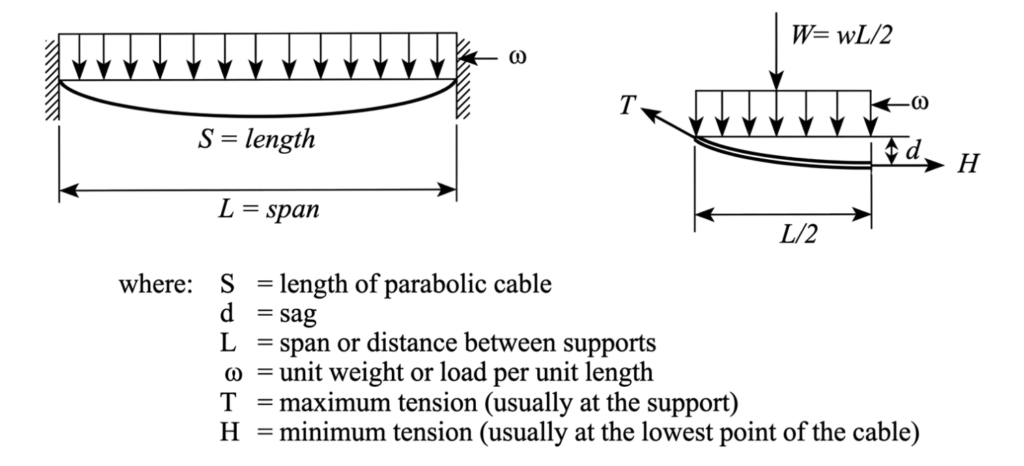
When the loading on a flexible wire cable is uniformly distributed horizontally, such as in a suspension bridge deck, the cable hangs in the shape of a parabolic cable.
Parabolic Cable Formulas
Where: \(H\) = minimum tension at lowest point, \(T\) = maximum tension at support, \(w\) = load per unit horizontal length, \(L\) = horizontal span, \(d\) = sag, \(S\) = total cable length
EE Board October 1991
Example. A certain cable is suspended between two supports at the same elevation and \(500\text{ ft}\) apart. The load is \(500\text{ lbs}\) per horizontal foot including the weight of the cable. The sag of the cable is \(30\text{ ft}\). Calculate the total length of the cable.
Solution. Use the approximate formula for the length of a parabolic cable:
Answer: 504.76 ft
Catenary Cables
When a heavy uniform flexible cable hangs under the influence of its own weight only, it assumes the shape of a catenary curve described by \(y = c \cosh(x/c)\).
Catenary Cable Formulas
Where: \(T\) = maximum tension, \(H\) = minimum tension, \(w\) = unit weight per arc length, \(c\) = catenary parameter, \(y = c + d\), \(d\) = sag, \(S\) = half-length of cable
Example. A cable weighing \(0.4\text{ kg/m}\) and \(800\text{ m}\) long is to be suspended with a sag of \(80\text{ m}\). Determine the maximum tension.
Solution. Calculate the half-length \(S = 800 / 2 = 400\text{ m}\). Set \(y = c + 80\) and apply the catenary equation:
Find the vertical ordinate \(y\) and maximum tension \(T\):
Answer: 416 kg
Cables Under Concentrated Load
A cable carrying discrete concentrated loads forms straight line segments between load points. Each joint is analyzed as a concurrent force system in static equilibrium.
Joint Equilibrium Equations
ECE Board November 1998
Example. A load of \(100\text{ lb}\) is hung from the middle of a rope, which is stretched between two rigid walls \(30\text{ ft}\) apart. Due to the load, the rope sags \(4\text{ feet}\) in the middle. Determine the tension in the rope.
Solution. Analyze the half-span geometry and joint equilibrium at the load point. Half-span \(= 15\text{ ft}\), sag \(= 4\text{ ft}\):
Set up vertical force equilibrium (\(\Sigma F_y = 0\)):
Answer: 194 lbs
Centroid of Plane Area
The centroid \((\bar{x}, \bar{y})\) of a plane area represents the geometric center through which the first moment of area sums to zero.
- First moment of area: Product of component area and centroidal distance.
- Composite shape: Sum of component moments divided by total area.
- Symmetry axis: Centroid always lies along any axis of symmetry.
Composite Centroid Formulas
Where: \(\bar{x}, \bar{y}\) = centroid coordinates of composite area, \(a_i\) = area of component \(i\), \(x_i, y_i\) = centroid coordinates of component \(i\), \(A\) = total composite area
Example. Find the location of the centroid of the composite area consisting of a \(10\text{-inch}\) square surmounted by a semi-circle. The centroid of a semicircle is located \(4r/(3\pi)\) above its base (diameter).
Solution. Calculate component areas and centroidal distances from the bottom edge:
Component 1 (Square): \(A_1 = 10 \times 10 = 100\text{ sq. in.}\), \(y_1 = 5\text{ in.}\)
Component 2 (Semi-circle): \(r = 5\text{ in.}\), \(A_2 = \pi r^2 / 2 = \pi(5)^2 / 2 = 39.27\text{ sq. in.}\)
Compute composite centroid ordinate \(\bar{y}\):
Answer: 7.0 inches from the bottom
Moment of Inertia
Moment of inertia (also called second moment of area) is a geometric property measuring an area’s resistance to bending or rotation about a given axis.
Second Moment of Area Formulas
Where: \(I_x, I_y\) = second moments of area about x and y axes, \(y, x\) = perpendicular distances to differential element \(dA\)
Example. A rectangle has a base of \(3\text{ cm}\) and a height of \(6\text{ cm}\). What is its second moment of area (in \(\text{cm}^4\)) about an axis through the center of gravity and parallel to the base?
Solution. Apply the centroidal moment of inertia formula for a rectangle:
Answer: 54 cm⁴
Polar Moment of Inertia
Polar moment of inertia \(J\) measures the resistance of a cross section to torsional deformation about an axis perpendicular to its plane.
Polar Second Moment Formula
Where: \(J\) = polar moment of inertia, \(I_x, I_y\) = rectangular moments of inertia, \(D\) = diameter of circular area
EE Board March 1998
Example. A circle has a diameter of \(20\text{ cm}\). Determine the moment of inertia of the circular area relative to the axis perpendicular to the area through the center of the circle in \(\text{cm}^4\).
Solution. Compute the polar moment of inertia \(J\) for a circle of diameter \(D = 20\text{ cm}\):
Answer: 15,708 cm⁴
Transfer Formula for Moment of Inertia
The transfer formula (Parallel Axis Theorem) calculates moment of inertia about any non-centroidal axis parallel to a centroidal axis.
Parallel Axis Theorem
Where: \(I\) = moment of inertia about target axis, \(I_g\) = centroidal moment of inertia, \(A\) = section area, \(d\) = perpendicular distance between parallel axes
EE Board March 1998
Example. An isosceles triangle has a \(10\text{ cm}\) base and a \(10\text{ cm}\) altitude. Determine the moment of inertia of the triangular area relative to a line parallel to the base and through the upper vertex in \(\text{cm}^4\).
Solution. Find centroidal moment \(I_g\), area \(A\), and distance \(d\) from centroid to vertex:
Apply the parallel axis theorem:
Answer: 2,500 cm⁴
Moment of Inertia With Respect to Inclined Axis
When coordinate axes are rotated through an angle \(\theta\), second moments of area transform according to inclined axis formulas.
Transformation Equations for Inclined Axes
Where: \(I_x, I_y\) = rectangular moments of inertia, \(I_{xy}\) = product of inertia, \(\theta\) = angle of axis rotation
Example. A section has centroidal moments of inertia \(I_x = 100\text{ cm}^4\), \(I_y = 60\text{ cm}^4\), and product of inertia \(I_{xy} = 0\). Determine the moment of inertia \(I_u\) about an axis inclined at \(\theta = 30^\circ\) to the x-axis.
Solution. Substitute values into the inclined axis transformation formula:
Answer: 90 cm⁴
Mohr’s Circle
Mohr’s Circle for moment of inertia is a graphical representation used to find principal moments of inertia and values about inclined axes.
- Center of circle: Average moment of inertia.
- Radius of circle: Maximum shearing inertia radius.
- Principal moments: Maximum and minimum second moments of area.
Mohr’s Circle Equations
Where: \(C\) = center coordinate of Mohr circle, \(R\) = circle radius, \(I_{\max}, I_{\min}\) = principal moments of inertia
Example. Given \(I_x = 50\text{ cm}^4\), \(I_y = 20\text{ cm}^4\), and \(I_{xy} = 20\text{ cm}^4\). Find the maximum principal moment of inertia \(I_{\max}\) using Mohr’s circle relations.
Solution. Calculate Mohr circle center \(C\) and radius \(R\):
Compute maximum principal moment of inertia \(I_{\max}\):
Answer: 60 cm⁴
Mass Moment of Inertia: Sphere, Spherical Shell, Cylinder
Mass moment of inertia \(I\) measures the resistance of a rigid body to rotational acceleration about an axis (\(I = \int r^2 dm\)).
Mass Moment of Inertia Formulas
Where: \(I\) = mass moment of inertia, \(m\) = total mass, \(r\) = radius
ECE Board April 1998
Example. What is the inertia of a bowling ball (\(\text{mass} = 0.5\text{ kg}\)) of radius \(15\text{ cm}\) rotating at an angular speed of \(10\text{ rpm}\) for \(6\text{ seconds}\)?
Solution. Model the bowling ball as a solid sphere (\(r = 0.15\text{ m}\), \(m = 0.5\text{ kg}\)):
Answer: 0.0045 kg-m²
ECE Board April 1999
Example. What is the moment of inertia of a cylinder of radius \(5\text{ m}\) and mass of \(5\text{ kg}\)?
Solution. Apply the mass moment of inertia formula for a solid cylinder:
Answer: 62.5 kg-m²
Centroidal Moment of Inertia of Common Shapes
Centroidal second moments of area \(I_g\) for standard geometric plane shapes:
Common Centroidal Moments of Inertia
Where: \(b\) = base width, \(h\) = height, \(D\) = circle diameter, \(a\) = semi-major axis, \(b\) = semi-minor axis
Example. Find the centroidal moment of inertia about the x-axis for a triangle with a base of \(12\text{ cm}\) and a height of \(6\text{ cm}\).
Solution. Apply the centroidal moment formula for a triangle:
Answer: 72 cm⁴
Moment of Inertia With Respect to Base
The moment of inertia \(I_b\) about an axis passing along the base edge of a plane figure:
Base Moment of Inertia Formulas
Where: \(b\) = base edge length, \(h\) = height perpendicular to base
ME Board October 1993
Example. The moment of inertia of a section \(2''\) wide \(\times 2'\text{ }0''\) high about an axis \(1'\text{ }0''\) above the bottom edge of the section is:
Solution. Identify section dimensions \(b = 2\text{ in.}\), \(h = 24\text{ in.}\) Target axis is \(12\text{ in.}\) above bottom edge, which is the centroidal axis:
Answer: 2304 in⁴
Formula Summary
Statics Formula Summary
| Formula Name | Formula |
|---|---|
| Equilibrium Equations | \(\Sigma F_x = 0\), \(\Sigma F_y = 0\), \(\Sigma M_O = 0\) |
| Frictional Resistance | \(F = \mu N\) |
| Angle of Friction | \(\tan\phi = \mu\) |
| Belt Tension Ratio | \(T_1 / T_2 = e^{\mu\beta}\) |
| Parabolic Cable Lowest Tension | \(H = w L^2 / (8d)\) |
| Parabolic Cable Support Tension | \(T = \sqrt{H^2 + (wL/2)^2}\) |
| Parabolic Cable Length | \(S = L + 8d^2/(3L) - 32d^4/(5L^3)\) |
| Catenary Tension | \(T = wy\), \(H = wc\) |
| Catenary Arc Relation | \(y^2 = S^2 + c^2\) |
| Composite Centroid | \(\bar{x} = \Sigma a_i x_i / A\), \(\bar{y} = \Sigma a_i y_i / A\) |
| Polar Moment of Inertia | \(J = I_x + I_y = \pi D^4 / 32\) |
| Parallel Axis Theorem | \(I = I_g + A d^2\) |
| Mohr Circle Principal Moments | \(I_{\max,\min} = C \pm R\) |
| Mass Moment of Sphere | \(I = (2/5) m r^2\) |
| Mass Moment of Cylinder | \(I = (1/2) m r^2\) |
| Centroidal Moment (Rectangle) | \(I_x = b h^3 / 12\) |
| Base Moment (Triangle) | \(I_b = b h^3 / 12\) |