
Age, Work, Mixture, Digit, Motion
Key ideas
- Age problems require assigning variables based on past, present, or future timeframes.
- Work problems rely on determining the fractional rate of work done per unit of time.
- Mixture components are found by multiplying the total volume by the substance’s percentage.
- Motion equations assume uniform velocity without acceleration.
Age Problems
Age problems are solved by relating past and future ages to a present variable.
- Present age: \( x \)
- \( y \) years ago: \( x - y \)
- \( y \) years from now: \( x + y \)
Work Problems
Work problems evaluate the time it takes to complete a specific task.
Formula
- Rate of work: \( r \)
- Time to finish: \( t \)
- Rate equation: \( r = \frac{1}{t} \)
When tasks involve multiple workers and specific outputs, calculate the man-hour rate.
Example. If 15 builders can construct 30 sheds in 6 hours, how many builders are needed to construct 10 sheds in 3 hours?
Solution. First, find the rate in builder-hours per shed.
Next, use this rate to find the required number of builders for the new task.
Answer: \( 10\ \text{builders} \)
Mixture Problems
Mixture problems track the specific quantities of individual components within a total volume.
- Component quantity = Total mixture volume \( \times \) Percentage of component
Digit Problems
Digit problems require separating a number into its individual place values.
- Two-digit number: \( 10t + u \)
- Three-digit number: \( 100h + 10t + u \)
Where \( h \) is hundreds, \( t \) is tens, and \( u \) is units.
Motion Problems
Motion problems describe movement at a uniform velocity.
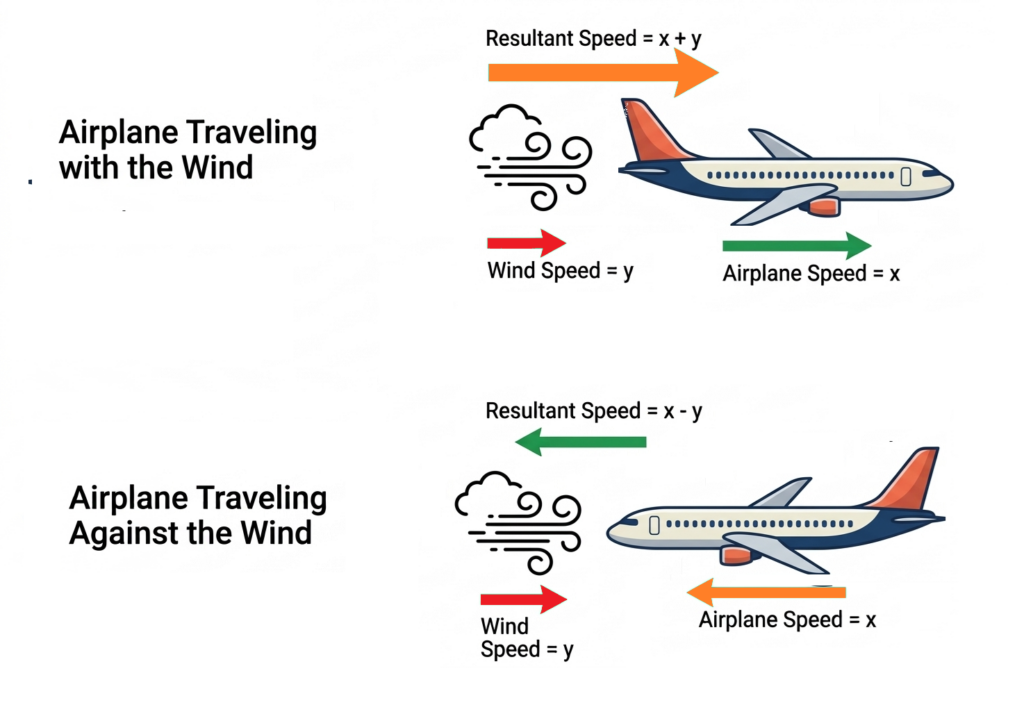
Formula
- Distance: \( D \)
- Velocity: \( V = \frac{D}{t} \)
- Time: \( t = \frac{D}{V} \)
US Coin Denominations
When solving word problems involving US currency, use the following equivalent values:
- Penny: 1 cent
- Nickel: 5 cents
- Dime: 10 cents
- Quarter: 25 cents
- Half: 50 cents
Formula summary
| Topic | Formula |
|---|---|
| Work | \( rt = 1 \) |
| Digit | \( 10t + u \) |
| Motion | \( D = Vt \) |
Additional facts. The 16th-century Italian mathematician and physician Gerolamo Cardano introduced the concepts of probability, defining it as favorable outcomes divided by possible outcomes, earning him the title “Father of the Theory of Probability.”
Quick check
If a pipe fills a tank in 4 hours, what is its rate of work per hour?
Show answer
\( 1/4 \) of the tank per hour. The rate is the reciprocal of the total time.
How do you represent the value of a three-digit number where the digits are reversed?
Show answer
\( 100u + 10t + h \). The units digit moves to the hundreds place and the hundreds digit moves to the units place.