
The Role of Catenary Equations in Sag and Tension Calculations
Derivation of the catenary equation from first principles — sag, maximum sag, and conductor length formulas for overhead transmission line design, explained step by step.
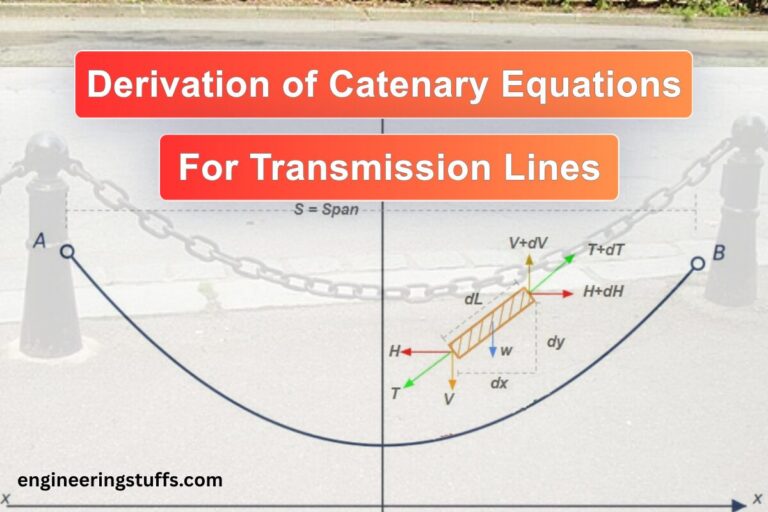
Derivation of the catenary equation from first principles — sag, maximum sag, and conductor length formulas for overhead transmission line design, explained step by step.

Calculate conductor sag and tension using the SPE (fixed plastic elongation) or Linear Elongation model. Supports bimetallic ACSR and homogeneous conductors, multiple weather cases, and downloadable PDF reports.

We rely on software like PLS-CADD for transmission line design, but understanding the underlying math makes you a better engineer. In this post, we break down the exact hyperbolic catenary equations and 4th-order stress-strain polynomials used in the Experimental Plastic Elongation (EPE) method. Follow a step-by-step hand calculation for a Drake ACSR conductor under NESC extreme loading, and see exactly how the fundamental math compares to industry-standard software outputs.
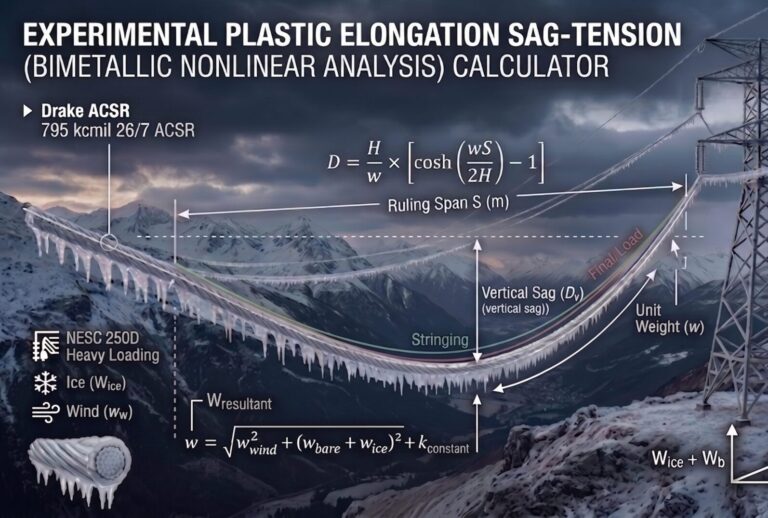
Calculate exact hyperbolic sag and tension for ACSR conductors using the industry-standard bimetallic nonlinear (EPE) method. This interactive tool independently evaluates the thermal and mechanical strain on aluminum outer strands and steel cores under NESC extreme loading conditions. Determine true vertical sag, permanent creep, and permanent load elongation (PCP) without relying on parabolic approximations. For educational and reference purposes.

How do engineers calculate sag and tension in overhead power lines? This article breaks down the key formulas, including the catenary curve and conductor length, and explains how factors like weather and temperature affect these calculations.