Linear and SPE Sag Tension Calculator
Notice: For educational and reference use only.
Results must be independently verified by a licensed engineer before use in any design or construction.
This site accepts no liability for errors or consequences arising from use of this tool.
Calculation Model
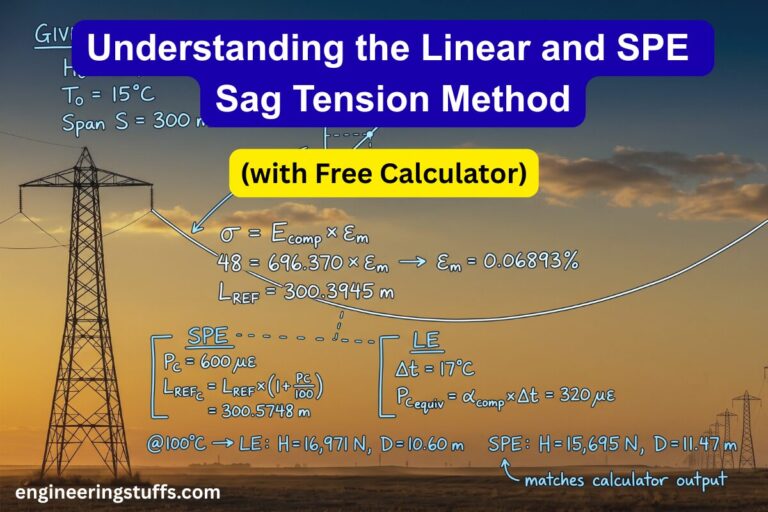
SPE applies a fixed permanent-elongation value (PC) directly, in microstrain.
LE instead applies an equivalent temperature shift (Δt) — because LE's stress-strain
relationship is purely linear, shifting the reference temperature by Δt produces the same
strain offset a directly-specified PC would, via the conductor's composite thermal expansion
coefficient. Same physical effect (permanent creep elongation), two equivalent parameterizations.
Typical value for ACSR: 600 µε (CIGRE TB 324 §6.2).
Equivalent temperature shift for creep (PLS-CADD §9.1). Typical 15–20°C for ACSR.
Conductor Library
Preset values are representative/typical for the conductor family shown — always verify
against manufacturer or CIGRE TB 324 tables for your exact conductor size before use in design.
Selecting a preset auto-fills all fields below, including the conductor type toggle.
Conductor Properties — Drake 795 kcmil 26/7 ACSR
Span & Stringing
Weather Cases
Under column PCP, check the weather cases to be included in the final after-load evaluation.
| # | Description | T°C | Ice cm | Wind Pa | k (N/m) | PCP | |
|---|---|---|---|---|---|---|---|
| 1 | |||||||
| 2 | |||||||
| 3 | |||||||
| 4 | |||||||
| 5 | |||||||
| 6 | |||||||
| 7 | |||||||
| 8 | |||||||
| 9 | |||||||
| 10 |
📐
Configure inputs and press Calculate