Understanding the Linear and SPE Sag Tension Method (with Free Calculator)
In the previous post I walked through the EPE (Experimental Plastic Elongation) method — the most accurate of the three conductor elongation models recognised by CIGRE Technical Brochure 324 [1]. In this post I cover the other two: the Linear Elongation (LE) model and the Simplified Plastic Elongation (SPE) model. Both are simpler and faster than EPE, and both are still widely used in practice — especially for preliminary design or where conductor polynomial data are not available.
The worked example follows CIGRE TB 324 §6.2 [1] directly, using Drake 795 kcmil 26/7 ACSR in a 300 m level span installed at 48 MPa (≈ 22.5 kN) at 15°C. This lets you check every number I produce against a published reference.
The Three Conductor Elongation Models
CIGRE TB 324 §5 [1] classifies sag-tension methods by how they represent conductor elongation. The table below summarises the key distinctions:
| Model | Stress-strain | Thermal α | Plastic elongation | Knee-point? |
|---|---|---|---|---|
| LE — Linear | Single composite E | Composite α_comp | None (or temperature shift Δt) | No |
| SPE — Simplified PE | Single composite E | Composite α_comp | Fixed user-input PC (µε) | No |
| EPE — Experimental PE | Per-component 4th-order polynomials | Per-component αO, αC | Derived from O-C polynomial | Yes |
The fundamental limitation of LE and SPE is that they treat the entire ACSR conductor as a single homogeneous elastic material. This works reasonably well at moderate temperatures, but it cannot reproduce the bilinear sag-temperature behaviour caused by load-shifting between the aluminium strands and the steel core above the knee-point — a point demonstrated clearly by Alawar et al. [2] and confirmed by the CIGRE graphical examples in §6 [1].
Step 1 — Composite Modulus and Thermal Coefficient
Both LE and SPE treat the conductor as if it were made of one material, with properties area-weighted from the outer and core components (CIGRE TB 324 Eqs 19 and 21 [1]):
Compare these with the EPE model: EPE keeps αO and αC separate and applies them per-component. The composite α of 18.82 µε/°C is a weighted average that is correct when both components carry load together, but loses accuracy when the aluminium sheds load to the core at high temperatures.
Step 2 — Reference Length (LREF)
CIGRE TB 324 §6.2 [1] begins with Drake ACSR installed at a composite stress of 48 MPa at 15°C in a 300 m span:
Thermal slide at T₀ = 15°C
The free thermal contraction between the installation temperature and the reference temperature TR = 21.11°C:
Mechanical strain and total elongation
For a linear elastic conductor, mechanical strain is simply stress divided by modulus (PLS-CADD Manual §9.1, Eq 9-10 [3]):
Catenary arc length and LREF
The small difference from CIGRE’s 8.0 m is because CIGRE uses the parabolic approximation D ≈ wS²/8H for clarity in their graphical examples, while we use the exact hyperbolic catenary.
The Linear Elongation (LE) Model
In the LE model there is no permanent elongation at all — the conductor behaves as a perfectly elastic spring. The stress-strain relationship is simply (PLS-CADD §9.1 Eq 9-10 [3]):
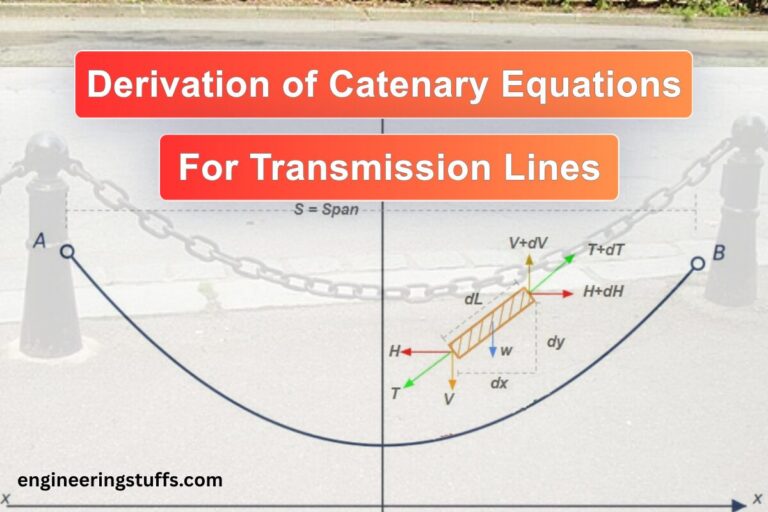
To find tension at any temperature T and weight w, this constitutive law is combined with the catenary arc-length equation. Both H and the conductor’s arc length depend on each other, so the system has to be solved simultaneously rather than algebraically rearranged:
There’s no closed-form solution for H here — Lcat(H) is transcendental. In practice this is solved iteratively (bisection, secant, or Newton’s method), which is exactly what the calculator does under the hood. If you want to see that iteration explicitly — the kind you’d set up with Excel’s Goal Seek or a manual bisection loop — I’ve written up the full convergence table in a companion post using this exact Drake example.
The LE model has no Final/Creep or Final/Load shift unless a creep temperature equivalent Δt is supplied. With Δt = 0, all three conditions are identical — the conductor is assumed never to creep and never to permanently stretch under load.
LE result at T = 100°C (bare wire)
Adding creep to LE: the equivalent temperature shift (Δt)
LE has no separate plastic-elongation term the way SPE does — but you can still fold creep into it, using a trick borrowed from PLS-CADD §9.1 [3]: rather than specifying a permanent elongation directly, you specify an equivalent temperature shift Δt. Because LE’s stress-strain law is linear, shifting the reference temperature by Δt produces exactly the same strain offset a directly-specified PC would — just expressed through the composite thermal coefficient instead of as a standalone constant:
Solving the same catenary-modulus system as before, but with this longer LREFΔt, gives:
Compare this to LE with Δt = 0 (H=16,971 N, D=10.60 m at 100°C, no creep at all) and SPE with PC=600 µε (H=15,695 N, D=11.47 m at 100°C, full typical creep). Δt=17°C sits between the two, as expected — it’s a lighter creep assumption (320 µε) than SPE’s typical 600 µε value. Neither number is “correct” in an absolute sense; both are engineering judgment calls about how much permanent elongation to assume for a conductor that hasn’t actually been tested.
The SPE Model — Adding a Fixed Plastic Elongation
The SPE model improves on LE by accounting for permanent elongation, but keeps it simple: the plastic elongation PC is a single fixed number chosen by the engineer based on experience or field data. CIGRE TB 324 §6.2 [1] uses PC = 600 µε (0.06%) as a typical representative value for ACSR.
The mechanism is straightforward. The plastic elongation shifts the conductor’s zero-stress reference point to the right — the conductor is permanently longer than when new. Graphically this is the move from point B to point C in CIGRE Fig 28 [1]:
LREF for Final/Creep condition
The conductor’s effective unstressed length has increased by 300.5748 − 300.3945 = 0.1803 m = 180.3 mm. Over a 300 m span this is 600.8 µε — exactly the PC we put in. ✓
SPE Final/Creep at T = 15°C
With LREFC in place, we solve the catenary-modulus system at the stringing temperature to find the new tension after creep:
The initial tension has dropped from 22,495 N to 19,915 N (−11.5%) and sag increased from 7.99 m to 9.03 m (+1.04 m). That is a significant change, which is exactly why ignoring creep in the LE model gives unconservative final sags.
SPE Final/Creep at T = 100°C
Shift the thermal slide by α_comp × (100 − 15) = 0.001882 × 85 = 0.160% (1,600 µε), then solve the catenary at the longer LREFC:
Again the match with CIGRE is very close — the small difference comes from our exact catenary vs CIGRE’s parabolic approximation.
Results — Temperature Scan (Bare Wire)
Here is the full temperature scan comparing the three model outputs for Drake ACSR at 300 m span, strung at 48 MPa (22.5 kN) at 15°C. All three conditions shown for SPE (PC = 600 µε); the LE model with Δt = 0 gives H_I = H_C = H_L at each temperature.
| Temperature | LE / SPE Initial | SPE Final/Creep (PC=600µε) | Difference (Creep − Initial) | |||
|---|---|---|---|---|---|---|
| H (N) | Sag (m) | H (N) | Sag (m) | ΔH (N) | ΔSag (m) | |
| −29°C (Cold uplift) | 27,914 | 6.438 | 23,724 | 7.578 | −4,191 | +1.139 |
| 15°C (Stringing) | 22,495 | 7.992 | 19,915 | 9.030 | −2,580 | +1.038 |
| 16°C (60°F) | 22,401 | 8.026 | 19,846 | 9.061 | −2,555 | +1.036 |
| 32°C (90°F) | 21,018 | 8.555 | 18,826 | 9.553 | −2,192 | +0.999 |
| 49°C (120°F) | 19,771 | 9.096 | 17,886 | 10.057 | −1,885 | +0.962 |
| 75°C (167°F) | 18,198 | 9.884 | 16,669 | 10.794 | −1,529 | +0.910 |
| 100°C (212°F) | 16,971 | 10.601 | 15,695 | 11.467 | −1,276 | +0.866 |
- Creep adds about 1 m of sag at all temperatures when PC = 600 µε. This is the sag penalty over a 10-year service life that the LE model ignores entirely.
- The ΔSag is largest at cold temperatures. Counter-intuitive at first, but it makes sense: at cold temperatures the conductor is tighter (higher tension), so the LREF shift from creep produces a larger fractional sag increase per unit length change.
- No knee-point appears in these results. The sag increases smoothly and monotonically with temperature — the composite-α model cannot reproduce the slope change that EPE and field measurements show above ~90°C for Drake ACSR.
How Does This Compare to EPE?
All three models below use identical assumptions: Drake ACSR, 300 m span, H₀ = 22,495 N, T₀ = 15°C, bare wire at 100°C. The EPE numbers are from the actual calculator (not a hand estimate) — I re-ran it with the matching installation tension specifically for this comparison:
| Model | H at 100°C (N) | Sag at 100°C (m) | Notes |
|---|---|---|---|
| LE Initial (Δt=0) | 16,971 | 10.60 | No creep modelled |
| SPE Final/Creep (PC=600 µε) | 15,695 | 11.47 | Fixed, engineer-assumed PC |
| EPE Final/Creep | 17,489 | 10.29 | PCouter=390.8 µε, derived from actual polynomial curves |
This is worth pausing on, because the direction of the difference is not what you’d guess from the theory alone. SPE assumes a flat PC = 600 µε regardless of loading history. EPE, working from the real stress-strain polynomials for this specific installation (H₀=22,495 N, a comparatively light 20%RTS stringing tension), derives a much smaller PCouter = 390.8 µε on its own — because the aluminum strands were never stressed hard enough during their loading history to plastically deform by anywhere near 600 µε. The result: EPE predicts less sag than SPE at 100°C (10.29 m vs 11.47 m), not more.
That’s the real risk with SPE’s fixed-PC approach: 600 µε is a reasonable typical value across many installations and loading histories, but for a specific line strung at a specific tension, the actual plastic elongation can be meaningfully lower (as here) or higher, depending on whether the conductor’s controlling weather case pushes the aluminum strands harder than a light stringing tension would suggest. EPE’s common-point / PCP mechanism (see the EPE post) accounts for this automatically; SPE just can’t, by design.
Separately, CIGRE TB 324 §6.3 [1] makes a related but different point, using its own illustrative example at a much higher 60 MPa (28 kN) installation tension: at that heavier stringing condition, EPE gives a maximum loaded tension about 4,200 N lower than LE/SPE, because the aluminum strands there plastically deform more than a fixed PC would predict. Same underlying mechanism as above — EPE adapts to actual loading history — just pushing in the opposite direction because the installation condition is different. The lesson generalizes: SPE’s fixed PC can either overestimate or underestimate real creep, and which way it errs depends on the specific line’s stringing tension and loading history, not on the conductor alone.
When to Use Each Model
| Situation | Recommended model | Reason |
|---|---|---|
| Preliminary / feasibility | LE with Δt = 15–20°C | Fast, needs only E and α; acceptable for early screening |
| Standard ACSR, T < 75°C | SPE with PC = 600 µε | Accounts for typical creep; below knee-point; widely used |
| High-temperature operation (T > 75°C) | EPE | Only model that correctly tracks knee-point behaviour [1, 2] |
| HTLS conductors (ACSS, ACCC) | EPE | Core-dominant behaviour above knee-point requires per-component model |
| Conductor without polynomial data | SPE or LE | EPE requires four polynomial curves from laboratory testing |
Try the Calculator
The SPE / Linear calculator implements both models, switchable via the model selector. For SPE, enter your PC value in µε. For the linear model, enter a creep temperature shift Δt. The CIGRE example from this post can be reproduced exactly using:
- Span S = 300 m, H₀ = 22,495 N, T₀ = 15°C
- All Drake wire data as shown in the table above
- SPE model, PC = 600 µε
The calculator also supports a Homogeneous conductor mode (AAC, AAAC, hard-drawn copper) alongside the bimetallic ACSR case worked through above. For a homogeneous conductor there’s no steel core to split load with, so the EFC/αC fields are removed from the calculation entirely — E and α are entered as the material’s actual (not area-weighted) values, and the same LE/SPE math applies unchanged.
Results must be independently verified by a licensed engineer before use in any design or construction. The site accepts no liability for errors or omissions.
The interactive SPE / Linear calculator lives on its own page, so it doesn’t slow down this post for readers who are just here for the theory.
Open the SPE / Linear Calculator →References
- CIGRE Working Group B2-12, Sag-Tension Calculation Methods for Overhead Lines, Technical Brochure 324, CIGRE, Paris, June 2007.
- Alawar, A., Bosze, E.J., and Nutt, S.R., “A Hybrid Numerical Method to Calculate the Sag of Composite Conductors,” Electric Power Systems Research, Vol. 76, pp. 389–394, 2006.
- Power Line Systems, PLS-CADD Version 21.00 User’s Manual, §9.1, Power Line Systems Inc., Madison WI, 2025.
- Winkelman, P.F., “Sag-Tension Computations and Field Measurements of Bonneville Power Administration,” AIEE Transactions on Power Apparatus and Systems, Vol. 78, Issue 4, pp. 1532–1548, February 1960.
What’s Next
If you want to see the iteration behind these numbers laid out explicitly — the kind of bisection loop you could set up yourself in Excel with Goal Seek — see the companion post, Step-by-Step SPE Sag-Tension Iteration, which walks through the exact convergence for this Drake example.
From there, the next post extends the single-span analysis to the ruling span — the key concept behind stringing charts for sections with multiple unequal spans. The ruling span formula, first derived by Winkelman [4], is what lets you run one sag-tension calculation per section instead of one per span.
Questions or corrections? Drop a comment below.